
Trickcal:Chibi Go
BILIBILIRole Playing
4.8615.00 Reviews
- Version
- 1.5.1
- Installs
- 1.00M
- Age Rating
- Teen
Screenshots

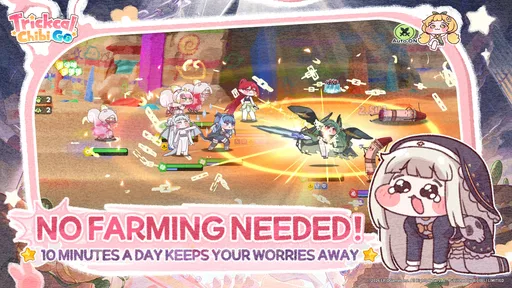
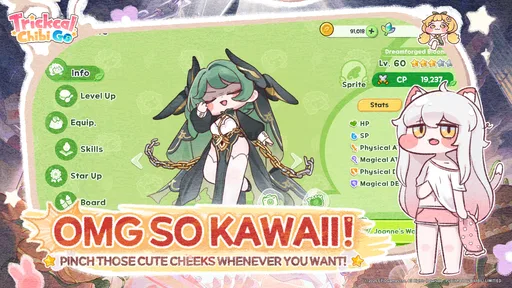

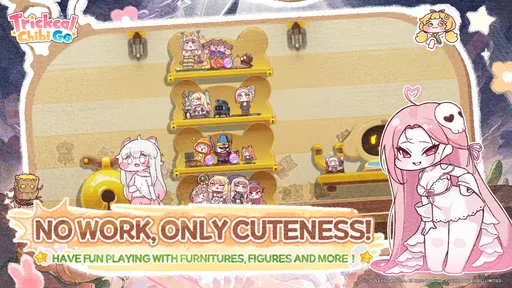

Our Review of Trickcal:Chibi Go
 Analysis by Appyee
Trickcal:Chibi Go is the kind of role-playing game I can open when I have a few spare minutes rather than needing to prepare for a long session. Its cheerful chibi presentation makes a friendly first impression, but the real appeal is the compact rhythm: check what is available, make a few sensible choices, improve the team, and leave before the game starts feeling like another obligation. I found that the experience works best when I treat it as a small daily routine instead of trying to force progress through it all at once.
That approach fits the store summary, “10 mins a day, worries away,” without making the game feel empty. There is enough character-building and decision-making to give short visits a purpose, while the light visual style keeps the mood relaxed. BILIBILI is the developer, and the game sits in the role-playing category with a Teen content rating. It is free to start, although optional purchases range from $0.99 to $99.99 per item, so the way you manage your attention and spending matters as much as the way you manage your team.
How a normal session settles into a useful routine
My preferred baseline workflow is simple. I begin by checking the current tasks and available rewards, then look at the characters or resources that can benefit from immediate attention. I avoid spending everything just because a button is available. That small pause is important in a game built around repeated short visits: a reward that seems useful now may be more valuable when it supports a clear upgrade or helps me pass a difficult encounter later.
The game’s “Chibi Go” identity is most effective here. The presentation makes routine management feel less severe than in a darker, more demanding role-playing game. I do not feel that every login has to become a major planning exercise. At the same time, the cute style should not lead new players to assume that every choice is interchangeable. When progress slows, it is usually worth looking at the team’s overall balance rather than simply pushing the same upgrade button repeatedly.
A practical everyday scenario is a short break between errands. I can open the game, collect what has accumulated, review the next achievable objective, and make one or two deliberate improvements. If I have more time, I can continue experimenting; if not, I can close it without feeling that I abandoned a long mission. This makes it a better fit for people who prefer bite-sized progression than for players who want a deep, uninterrupted adventure every evening.
I also recommend deciding what “progress” means before spending resources. Sometimes the sensible goal is improving the main group. At other times, completing a task or preparing for a specific challenge may offer more value. I found that keeping one immediate goal prevents the usual free-to-play drift, where a player taps through every available screen and ends the session with fewer resources but no meaningful improvement.
What to do when you only have a few minutes
For a very short visit, I would use a three-step loop: collect, inspect, then commit. Collection comes first because it clears the clutter from the interface. Inspection means checking which objective, character, or upgrade is closest to completion. Commitment means choosing one action that supports that priority instead of scattering resources across several unrelated improvements.
This habit is more useful than rushing through every menu. It also makes the game easier to return to after a busy day because I leave myself a clear next step. If I know that the next session begins with a particular upgrade or task, I spend less time rediscovering what I was doing.
Players who enjoy role-playing games for story, character attachment, and gradual team development will probably appreciate this rhythm. Players who mainly want constant combat may find the management portions too prominent. Likewise, anyone expecting a single-player console-style campaign with a fixed beginning and end should approach this as an ongoing mobile routine instead.
Why the free entry point needs a personal rule
The game is free, which makes it easy to try without a commitment. The more important question is whether you can enjoy the loop without treating purchases as the default solution to every slowdown. I prefer to set a rule before I begin: optional spending should solve a deliberate preference, not a moment of impatience. That is especially relevant because the available purchase range reaches from small impulse amounts to much larger bundles.
I would not describe this as a reason to avoid the game entirely. It is simply part of the decision. If you enjoy collecting, optimizing, or accelerating progress, the purchase structure may be tempting. If you want a completely fixed-cost experience, a premium role-playing game without optional purchases may suit you better. Trickcal:Chibi Go is most comfortable for me when purchases remain optional rather than becoming part of the daily routine.
Settings, shortcuts, and habits that make the game easier to live with
Before settling into regular play, I would spend a few minutes checking the available settings rather than accepting every default. On a phone, the most useful adjustments are usually the ones that reduce friction: sound levels, notification behavior, display preferences, and any option that affects how quickly routine screens can be reviewed. I do not assume every setting must be changed, but I do think the first session is the right time to make the game fit the way you use your device.
Sound deserves special attention. The bright chibi presentation can be enjoyable with audio, but I often play in places where repeated effects are distracting. Lowering or muting sound lets me keep the visual feedback while making short sessions more practical on public transport, during a break, or beside someone watching television. If you like the atmosphere, I would leave some audio enabled and adjust it rather than turning everything off automatically.
Notifications are another personal choice. Reminders can help players maintain a regular routine, but too many interruptions make a relaxing game feel demanding. I prefer notifications that support a specific reason to return and disable anything that turns the game into background pressure. The goal is to make the game available when I want it, not to let it dictate every spare moment.
Device compatibility is reasonably approachable: the game supports Android 8.0 and later. That does not guarantee identical performance on every phone, so I would still pay attention to heat, battery use, and loading comfort during the first few sessions. If the game feels unpleasant on an older device, reducing visual demands where possible is more sensible than forcing a long session. Short visits also help keep the experience comfortable on hardware that is no longer new.
One setting-related habit I value is separating “convenience” from “progress.” If an option makes menus easier to read or sessions quieter, it improves comfort. It does not necessarily make an upgrade more valuable. Keeping those ideas separate protects me from confusing a smoother interface with a reason to spend more resources. That distinction is easy to overlook in a colorful game where every screen encourages another tap.
Build a repeatable review order
I use the same review order each time: available rewards, active objectives, team condition, upgrade choices, and only then optional extras. A consistent order reduces missed tasks and prevents me from spending resources before I understand the day’s priorities. It is not a hidden shortcut; it is simply a reliable way to make a short session feel intentional.
For newer players, this order also answers a common concern: what should I do first after opening the game? Start with anything that expires or is time-sensitive if the interface presents it, then choose the improvement that supports the nearest meaningful goal. If nothing stands out, save resources rather than upgrading randomly. Waiting is a valid decision in a role-playing game, particularly when you are still learning which characters or improvements fit your preferred approach.
I would also keep notes mentally, or in a simple phone note, about what I am saving toward. This is useful when several attractive options appear at once. A short reminder such as “prepare the main group” or “finish the current objective” stops the session from becoming a tour of tempting buttons. The benefit is not faster tapping; it is better consistency.
Use the game’s short-session design instead of fighting it
Some mobile role-playing games reward long farming sessions, and that can make players feel guilty when they cannot keep up. Trickcal:Chibi Go is easier to enjoy when I accept its shorter cadence. I would rather complete a focused visit and return later than stretch a session until the game feels repetitive. This is one of the strongest reasons to recommend it to casual players who still want a sense of growth.
The trade-off is that players who love extended optimization may find the compact loop limiting. If your ideal evening involves comparing many builds, repeating battles for a long time, and making highly granular decisions, you may want a more systems-heavy alternative. Here, the pleasure comes from making a few good choices repeatedly, not from turning every session into a spreadsheet.
Faster patterns for experienced players
Once the basic routine is familiar, I stop treating every available action as equally urgent. I group similar decisions together: first review what can be claimed, then what can be upgraded, then what can be attempted. This keeps the session moving and makes it easier to notice whether I am actually improving the team or merely consuming resources.
Another useful pattern is to avoid changing several variables at the same time. If I alter the team, spend resources, and switch goals in one visit, it becomes difficult to understand what helped. I prefer to make one meaningful adjustment, test it through the next relevant challenge, and then decide whether another change is needed. This is slower in theory but more efficient over several sessions because it produces clearer feedback.
When a challenge does not go well, I would first inspect the preparation rather than immediately blaming luck. A weak result may come from an unbalanced group, an upgrade aimed at the wrong priority, or simply attempting content before the team is ready. The chibi presentation keeps the tone light, but the role-playing foundation still rewards patience. Repeating the same attempt without changing the underlying plan is usually the least useful form of persistence.
I also recommend keeping a reserve. Spending every resource as soon as it arrives creates a cycle where each new obstacle feels more expensive. A reserve gives me room to respond when a more important improvement becomes available. This is particularly helpful for free players, because it reduces the pressure to use purchases as a substitute for planning.
Where the faster approach stops helping
Efficiency should not mean skipping the parts that make the game enjoyable. I still take time to appreciate the character presentation and experiment when I am not trying to finish a specific task. A rigid routine can turn a playful role-playing game into a checklist, which defeats much of its charm.
There is also a limit to how much can be optimized from outside the game. I would not rely on generic tier lists or copy a popular setup without understanding why it works. Advice that ignores the resources you actually have, the objectives in front of you, or your willingness to spend can make a simple game more confusing. My better rule is to use outside opinions as ideas, then judge them against my own results.
Advanced limits and the moments when another game is better
The most important limitation is the tension between a relaxing daily loop and free-to-play progression. The game can be pleasant when I accept gradual progress, but impatience changes the mood quickly. If I feel that I must accelerate every obstacle, the short-session design no longer feels calming. That is a sign to step back, save resources, or choose a different kind of role-playing game.
The Teen content rating also helps set expectations. This is not a purely preschool-style experience simply because the characters are presented in a cute form. Parents should consider whether the game’s tone, role-playing structure, and optional purchases fit the player using the device. The friendly art style does not remove the need for sensible supervision around spending.
Its audience size suggests that the game has attracted substantial interest, with over one million installs and an average rating of 4.8 from around forty-eight thousand ratings. Those figures make it easier to see why it has reached a broad mobile audience, but they do not replace personal fit. A highly rated game can still be wrong for someone who dislikes daily routines, character management, or purchase prompts.
The current version is 1.5.1, so I would keep the app updated through the normal platform process when an update is offered. More importantly, I would judge the game after several ordinary sessions rather than after the first colorful impression. The opening presentation tells me whether I like the style; the repeated routine tells me whether I can live with the pacing.
Compared with a traditional role-playing game, this one asks for less uninterrupted time and offers a more casual visual identity. Compared with a purely idle game, it gives me more reason to pay attention to objectives and team choices. Compared with a competitive role-playing title, it feels less suitable for players whose main motivation is ranking pressure or constant mastery. Those differences are not flaws by themselves; they define the audience.
I would skip it if I want a one-time purchase with no optional spending, a long cinematic campaign, or combat that demands continuous manual control. I would also skip it if daily check-ins feel like chores. On the other hand, I would recommend it to someone who likes charming characters, modest planning, and a game that can fit into a lunch break without requiring a full evening.
My verdict after making the routine my own
The best way to enjoy Trickcal:Chibi Go is to treat it as a small, repeatable habit rather than a race. I get the most from it when I check settings early, keep a clear objective, preserve some resources, and make one thoughtful improvement at a time. Those habits do not add imaginary features to the game; they simply help the existing short-session structure work in my favor.
BILIBILI has made a role-playing game that is approachable without being completely mindless. Its chibi look softens the experience, while the progression loop gives regular visits a reason to exist. The free entry point is welcome, but optional purchases mean I would approach it with a spending boundary already in mind. That is the main trade-off behind the otherwise comfortable design.
For me, Trickcal:Chibi Go is worth trying if I want a friendly mobile RPG that respects short breaks and rewards steady attention. I would not call it the ideal choice for every role-playing fan, especially those seeking a deep long-form adventure or a completely purchase-free structure. But for a player who wants a manageable daily game, understands its limits, and enjoys improving a colorful team at a relaxed pace, it is an easy recommendation.
Verdict
Strengths of Trickcal:Chibi Go
- Charming chibi art style gives the game a distinctive visual identity.
- Turn-based battles are easy to learn but still offer strategic team choices.
- Frequent character interactions add personality beyond combat.
- Idle rewards let you make progress even during short play sessions.
- The compact download size is convenient for many mobile devices.
Limitations of Trickcal:Chibi Go
- Some progression systems may feel overwhelming for new players.
- Duplicate characters can be frustrating when building a preferred team.
- Higher difficulty stages may encourage repeated farming for upgrades.
- The small interface can feel crowded on phones with compact screens.
- Online features require a stable connection to access all content.
Other Releases by BILIBILI
View All
Jujutsu Kaisen Phantom Parade
Role Playing3.3
Similar Picks in This Category
View All
Hair Dye
CrazyLabs LTD4.4

Monster High™ Beauty Salon
CrazyLabs LTD4.5

Bus Simulator - Bus Games 3D
Jima Apps4.4

Flight Pilot: 3D Simulator
Wildlife Studios4.1


Super Stylist Fashion Makeover
CrazyLabs LTD4.4
Frequently Asked Questions
What is Trickcal:Chibi Go?
Trickcal:Chibi Go is a cute, character-focused mobile RPG built around collectible chibi heroes, story progression, battles, and team development. The game combines colorful anime-style presentation with strategic combat, character upgrades, and various activities to keep progression moving. It is designed for players who enjoy collecting heroes, improving their squads, and exploring a lighthearted fantasy world through short mobile-friendly sessions.
Is Trickcal:Chibi Go free to download and play?
Yes, Trickcal:Chibi Go can generally be downloaded and played for free, although it may include optional in-app purchases. These purchases can provide premium currency, summoning opportunities, resources, or progression-related items. You can usually experience the main content without paying, but players who want faster upgrades or more frequent character recruitment may encounter offers designed to encourage spending.
Does Trickcal:Chibi Go require an internet connection?
An internet connection is normally required for Trickcal:Chibi Go because the game may need to connect to its servers for account access, event content, updates, synchronization, and online features. Even if some sections appear suitable for offline play, you should not assume the complete game will work without connectivity. A stable connection is especially important during downloads, battles, summons, and account-related activities.
What type of gameplay and progression does Trickcal:Chibi Go offer?
The game focuses on building a team of collectible characters and improving them through levels, equipment, skills, and other progression systems. Players typically advance by completing stages, following the story, taking part in challenges, and managing their available resources. Team composition can matter because different heroes may provide different roles, abilities, or advantages in particular encounters.
Is Trickcal:Chibi Go suitable for all players and devices?
Trickcal:Chibi Go is a good choice for players who enjoy colorful chibi characters, anime-inspired visuals, collection systems, and RPG team management. However, compatibility can vary depending on your Android or iOS version, device hardware, available storage, and regional availability. The game may also contain optional purchases and online features, so parents should review device restrictions and spending controls before allowing younger players to download it.
Play our best games!


